Capital Event Strategy
Network Proximity: Why Your Connections to Decision-Makers Change Everything
Capital events are announced at Layer 2 months before they're visible at Layer 5. Your network proximity determines which layer you hear from.
When Your Team Doesn't Get The Call
Your organization watches a competitor win a federal contract that should have been yours. Not because they're more capable. Not because they're cheaper. But because they got the call six months before you heard about it even existing.
The winning company's CEO knew someone on the government side. Not a casual acquaintance—a real relationship. When the agency was designing the solicitation, that person called her. "We're thinking about doing this. Here's what we're trying to solve." Six months before SAM.gov posted anything official.
Your team's first you heard about it: the public announcement. Same day as 500 other organizations. By then, the winner was already six months into proposal development. They knew the decision-maker's priorities. They'd had time to build partnerships. They'd iterated their approach multiple times.
Your team had 30 days to deliver a proposal. They lost. And the frustrating part? You could have won. You had better capabilities. But you never had the time to show them.
This is the network proximity problem. Where you sit in the network determines when you hear about opportunities. And when you hear determines whether you win or lose.
Capital Events Flow Information Top-Down, Not Bottom-Up
Federal capital events don't appear randomly across the landscape. They cascade down through layers of insiders before they become public. Understanding these layers is the difference between seeing opportunities early and seeing them too late.
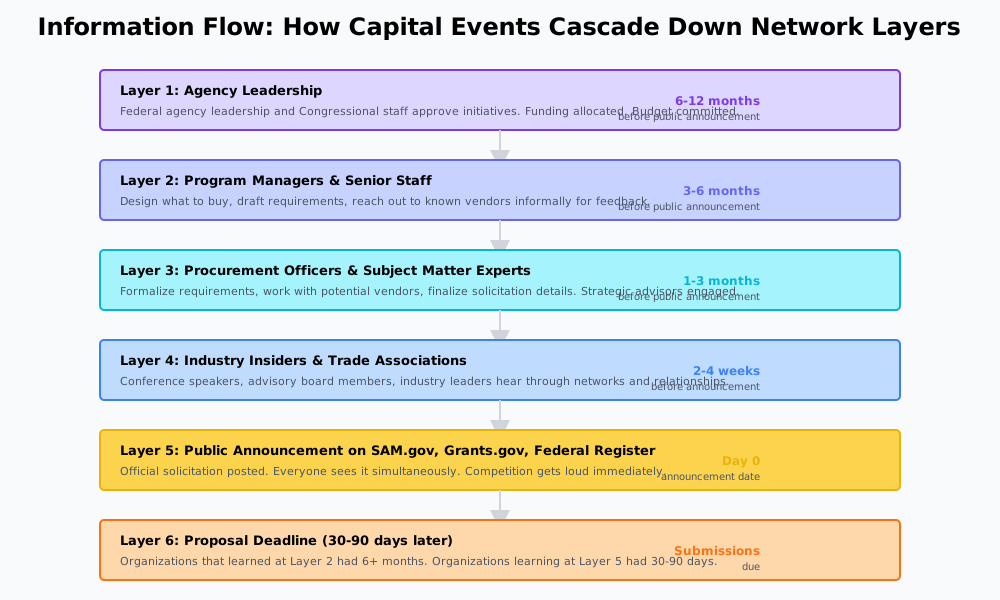
Figure 1: Capital events cascade down network layers. Organizations at Layer 2-3 have 3-6 months of advance notice. Organizations at Layer 5-6 have 30-90 days. The timing difference compounds into dramatically different win rates.
Layer 1: Agency Leadership (6-12 months early)
Federal agency leadership and Congressional staff approve major initiatives. A budget is allocated. A strategic direction is set. At this level, the capital event is decided but still completely invisible to most organizations.
Layer 2: Program Managers & Senior Staff (3-6 months early)
Program managers start designing what they actually want to buy. What problems need solving? What should requirements look like? At this stage, government procurement officers reach out to known vendors informally. "We're thinking about doing something in this space. What do you think we should ask for?"
Organizations with relationships at this layer get insider information about what the government will ask for before it's publicly released. They can design their offerings and proposals to align with emerging requirements. Organizations without these relationships will write proposals against published requirements, always 3-6 months behind in their understanding.
Layer 3: Procurement Officers & Subject Matter Experts (1-3 months early)
Details are formalized. Solicitation language is drafted. And strategic advisors, consultants, and "trusted vendors" are brought in for feedback. If you're in this layer through advisory roles, speaking engagements, or strategic partnerships, you know what's coming weeks before it's public.
Layer 4: Industry Insiders & Trade Associations (2-4 weeks early)
Industry conference speakers, federal advisory board members, and trade association leaders hear about emerging opportunities through their networks. They may not have formal access, but they're close enough to the decision-makers that information flows through relationships.
Layer 5: Public Announcement (Day 0)
The solicitation officially posts on SAM.gov, Grants.gov, or the Federal Register. Suddenly, 500+ organizations are aware of the opportunity simultaneously. The competition becomes loud immediately.
Layer 6: The Deadline Crush
Organizations that heard at Layer 2 have been developing for 3-6 months. Organizations that heard at Layer 5 have 30-90 days. The difference is catastrophic.
The Network Proximity Advantage: Quantified
Research from NSF, federal procurement data, and industry analysis shows something striking: Organizations with Layer 2-3 network proximity win 40-45% of the capital events they pursue. Organizations with Layer 5-6 proximity win 5-10%. That's a nearly 10x difference in win rate.
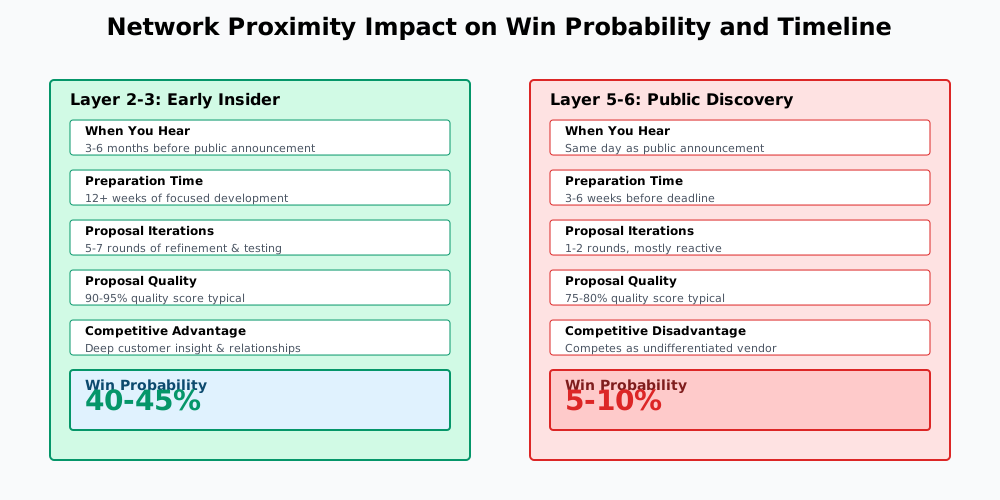
Figure 2: Network proximity determines win probability. The gap between Layer 2-3 and Layer 5-6 is nearly 8x in win rate. Early insiders have time to develop quality proposals. Public discoverers are inherently disadvantaged.
The difference isn't about being smarter or more capable. It's about time. Organizations learning about opportunities three months early can:
- Do customer research: Understand government problems deeply, not just respond to published requirements
- Build relationships: Create partnerships, align subcontractors, and strengthen customer connections
- Iterate proposals: Develop 5-7 versions instead of scrambling through 1-2 final drafts
- Develop competitive positioning: Know what competitors will do and position differently
- Train teams: Ensure everyone understands the customer's needs deeply, not superficially
Organizations learning about opportunities on announcement day can't do any of this. They submit whatever they can deliver in 30-90 days. And they lose to competitors that had three months.
Measuring Your Network Proximity: Three Diagnostic Questions
Where does your organization sit in these layers? Answer these questions honestly:
Question 1: Do decision-makers in your sector know who you are?
Not "would they hire you if they needed you." But literally: Would a Layer 2 program manager recognize your company name in a meeting about vendors in your space?
If program managers discussing a new initiative in your sector would mention you unprompted (even if negatively), you have Layer 3-4 proximity. If you're not in their mental map at all, you're at Layer 5-6.
Question 2: How do you typically learn about new opportunities?
Layer 2-3 signal: Someone calls you or emails you directly. "Hey, we're thinking about doing something in [sector]. Are you interested?" You learn about this opportunity before it's public.
Layer 5-6 signal: You see it on SAM.gov, in a press release, or from your team monitoring sources. You learn when everyone else does.
If more than 50% of your opportunities come from direct outreach or relationships, you're at Layer 3. If more than 80% come from public sources, you're at Layer 5-6.
Question 3: How far in advance do you typically learn about upcoming opportunities?
Layer 3 timing: 3-6 months before the public solicitation is posted
Layer 5 timing: Same day as public announcement
If your team is learning about opportunities weeks or months before they're public, you have network proximity built. If you're learning same-day or after, you don't.
Building Network Proximity: The Multi-Year Strategy
The bad news: Network proximity doesn't happen by accident. The good news: It's buildable. Organizations can move from Layer 5-6 to Layer 3-4 within 2-3 years through intentional effort.
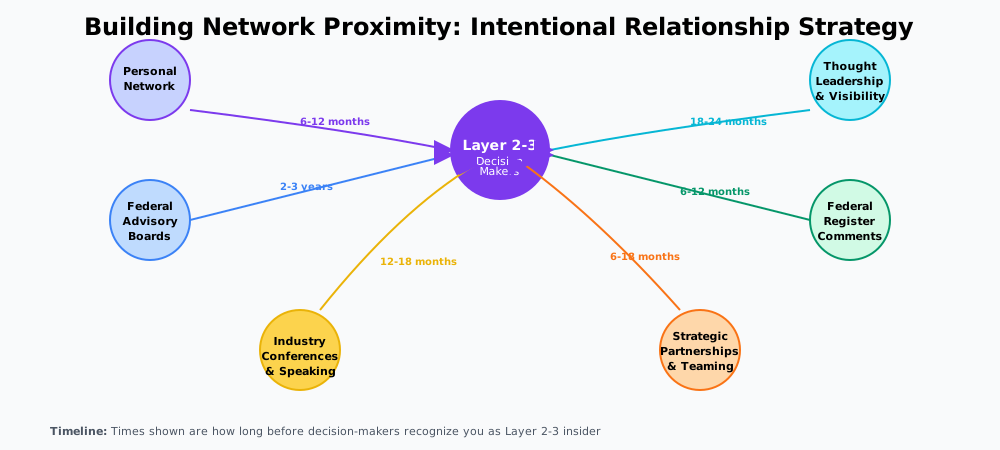
Figure 3: Multiple strategies build network proximity over time. Most organizations can move from Layer 5-6 to Layer 3-4 within 18-24 months through a combination of these approaches. No single strategy is sufficient alone.
Strategy 1: Personal Relationship Development (6-12 months to payoff)
Identify Layer 2-3 people in your sector explicitly. Don't wait for natural connections. Make it your job. Have your CEO and business development team build relationships with 2-3 key people at major agencies in your space.
This isn't about sales calls. It's about genuine relationship. Coffee meetings. Lunch conversations. Understanding their challenges. Offering insights without expecting immediate return. Over 6-12 months of consistent relationship, you become someone they'd call about emerging opportunities.
Strategy 2: Federal Advisory Boards (2-3 years to payoff)
Apply for federal advisory board roles. These boards meet with agency leadership regularly. Members are in Layer 1-2 conversations. They hear about emerging initiatives months before public announcement. Advisory board positions typically take 1-2 years to get, then payoff for 3-5 years.
Strategy 3: Industry Conferences & Speaking (12-18 months to payoff)
Speak at major industry conferences in your space. Co-present with federal employees. Participate in federal listening sessions. This puts you in Layer 4 conversations where you hear about emerging priorities early.
Strategy 4: Thought Leadership (18-24 months to payoff)
Build visibility as a sector expert through white papers, articles, research, and media appearances. Decision-makers start thinking of you as someone worth listening to. This takes longer but creates durable visibility that compounds.
Strategy 5: Federal Register Participation (6-12 months to payoff)
Actively comment on Federal Register notices in your sector. Agencies notice substantive comments. They also notice who participates consistently. Over 6-12 months, you become a recognizable voice in regulatory discussions.
Strategy 6: Strategic Partnerships & Teaming (6-18 months to payoff)
Partner with organizations that already have Layer 2-3 proximity. Teaming arrangements often require getting to know the partner's network. Over time, you inherit some of their network positioning.
Most successful organizations use a combination of these strategies simultaneously. Advisory board membership puts you in Layer 2 conversations. Speaking at conferences puts you in Layer 4 conversations. Personal relationships put you in direct contact with decision-makers. Over 2-3 years, these compound and you move from Layer 5-6 to Layer 3.
The Digital Employee Advantage: Monitoring While Relationships Build
Network proximity takes 2-3 years to build. But you can't wait that long to see opportunities. This is where a Capital Event Intelligence system becomes essential.
While your team is building relationships to move from Layer 5 to Layer 3, your digital employees are working 24/7 to ensure you don't miss opportunities. A capital event intelligence system continuously monitors SAM.gov, Grants.gov, agency websites, and the Federal Register.
The system alerts you to relevant opportunities the same day they're announced—so you can start your proposal work immediately rather than days or weeks later. Meanwhile, your network proximity building work continues. As those relationships mature and you move to Layer 3, you begin getting advance notice before public announcement. At that point, you're combining:
- Advance notice from relationships: Months ahead of announcement
- Digital monitoring: Immediate notification when announced publicly
- Institutional evaluation: Quick go/no-go decisions based on your criteria
- Proposal execution: Starting immediately after decision
This combination—network proximity plus digital infrastructure—creates the foundation for sustainable capital event success.
The Compounding Cost of Low Network Proximity
Most organizations don't measure their network proximity. They assume they're closer to decision-makers than they actually are. Then they're shocked when they lose capital events to "less qualified" competitors.
Here's what happens when network proximity is low:
- Year 1: You miss opportunities because you don't hear about them early enough. Win rate: 5-10%
- Year 2: You're demoralized from losses. Investment in relationship building is low. Still missing opportunities. Win rate: 5-10%
- Year 3: You're further behind. Competitors that invested in relationships in Year 1 are now seeing opportunities you don't. Win rate: 3-7%
The gap compounds because early movers build case studies and relationships from their wins, which further improves their positioning for future competitions. You're stuck at Layer 5-6, watching opportunities flow to better-positioned competitors.
The Decision: Build or Accept Disadvantage
Network proximity determines your competitive position in capital events. Organizations at Layer 2-3 win 40-45% of opportunities. Organizations at Layer 5-6 win 5-10%. That's not a small gap.
If you're currently at Layer 5-6, you have two choices:
- Accept the disadvantage: Continue learning about opportunities at announcement time, continue losing to better-positioned competitors, continue lower win rates
- Invest in building proximity: Spend 2-3 years intentionally building relationships with Layer 2-3 decision-makers. Deploy a Capital Event Intelligence system to see opportunities immediately when announced. Build your way toward 40%+ win rates.
Organizations that made this investment 2-3 years ago are now winning disproportionately in 2026. Organizations starting now will compound their advantage for the next 5 years. Organizations that don't start will fall further behind every year.
Assess Your Network Proximity Today
Most organizations underestimate how far they sit from decision-makers. Get clarity on which layer you're actually at, what it would take to move closer, and whether digital monitoring plus relationship building makes sense for your organization.
Find Your LayerFree Claude Skill assessment. Identify your current network proximity and what it means for your capital event strategy.