Discovery Gap
Why You're Missing $150K+ Opportunities
Your organization is seeing 1 in 5 capital events it qualifies for. The other four go to competitors. That's a $2.5M-$10M blind spot over 5 years.
The $150K Opportunity Your Team Didn't See
Three weeks ago, a federal program announced $150K in funding for AI apprenticeships. Up to $10K per intern per month. It was designed specifically for organizations building workforce capacity. Your organization fit perfectly.
By all rights, you should be writing the proposal right now. Instead, you don't even know this opportunity exists. Why? Because the announcement was posted on an agency website you don't monitor. It was listed in the Federal Register for 14 days. It never hit your radar. Two weeks later, another organization submitted their application. Your team is still unaware.
This isn't a one-time story. This is the pattern. NSF research shows that roughly 80% of eligible organizations never see the capital events they could win. Not because they're unqualified. But because they don't see the announcement.
Where Capital Events Go Invisible
Federal funding doesn't announce itself in one place. SAM.gov posts government contracts. Grants.gov posts federal grants. The Federal Register posts regulatory changes and agency announcements. State and local governments post on their own portals. Industry groups post partnership opportunities. University research centers post collaboration calls. Strategic partnerships announce on company websites.
A single organization monitoring all relevant sources would need to spend 20+ hours per week just scanning announcements. Most organizations don't have that capacity. So they rely on reactive discovery: occasionally checking sources, hearing about opportunities from colleagues, stumbling upon announcements weeks after they're published.
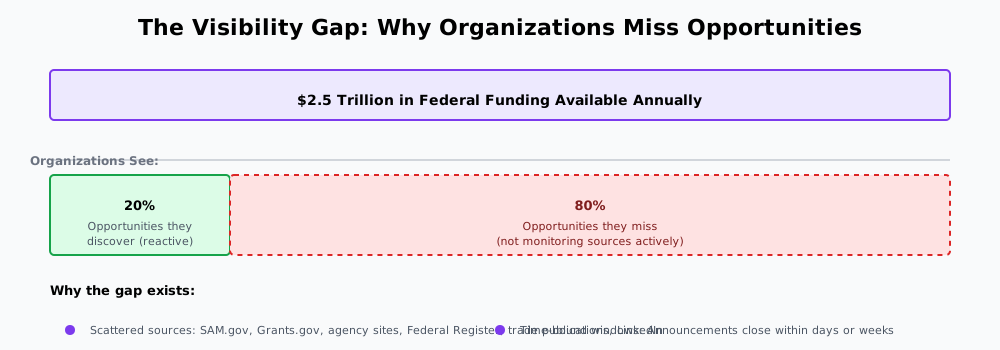
Figure 1: The visibility gap. Organizations relying on reactive discovery see roughly 1 in 5 capital events. The other 80% pass by unnoticed because they announce on platforms your team doesn't systematically monitor.
The Window Problem
Even if you eventually discover an opportunity, you're already behind. Federal contract solicitations typically have 30-60 day response windows. Federal grants typically have 60-90 day windows. State and local grants often have 30-45 day windows. Strategic partnerships might have 2-3 week selection windows.
If you discover an opportunity in week 3 of a 90-day window, you have 6 weeks. But competitive proposals need time for planning, team assembly, compliance research, and iteration. Organizations that started in week 1 have already completed multiple drafts and stress-tested their approach. You're still in planning mode.
What This Actually Costs
Consider a typical organization with access to 5-8 relevant capital events per year:
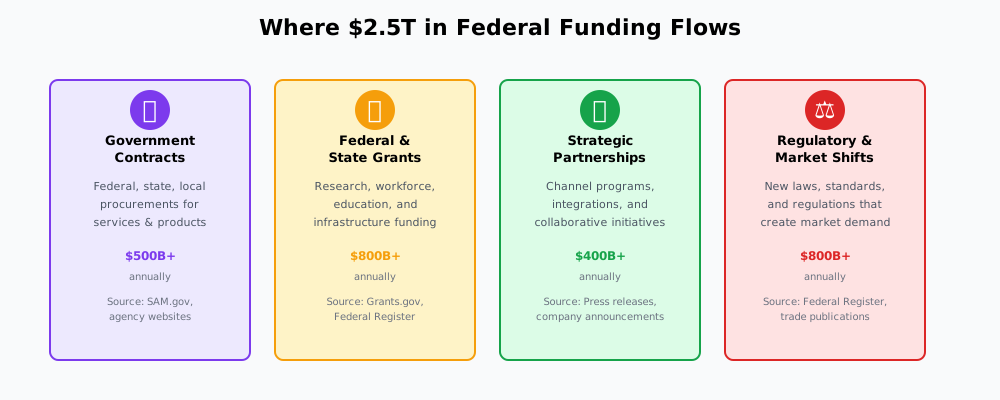
Figure 2: Types of capital events organizations encounter. Each type has different sources, timelines, and eligibility criteria. Missing even one per quarter costs $50K-$500K.
The Math of Missing Events
Scenario 1: Reactive Discovery (No System)
- Opportunities per year: 8 (organizations typically encounter this many)
- Win rate with reactive discovery: 15% (late start, lower quality proposals)
- Average opportunity value: $200K
- Expected annual capture: 8 × 15% × $200K = $240K
Scenario 2: Systematic Monitoring (Capital Event Intelligence)
- Opportunities per year: 8 (same universe)
- Win rate with early discovery: 35% (early start, higher quality proposals, better positioning)
- Average opportunity value: $200K
- Expected annual capture: 8 × 35% × $200K = $560K
Annual difference: $320K
5-year difference: $1.6M in lost competitive advantage
For larger organizations with bigger opportunities (averaging $500K-$2M), the gap compounds dramatically:
- Reactive discovery: 8 ops × 15% × $1M = $1.2M annually
- Systematic discovery: 8 ops × 35% × $1M = $2.8M annually
- Gap: $1.6M annually, $8M over 5 years
Why Organizations Stay Stuck in Reactive Mode
Understanding the cost is one thing. Understanding why organizations remain reactive despite knowing the cost is another.
Trap 1: "Nobody Has Time To Monitor"
Your team is focused on execution. Running programs, serving customers, managing operations. Nobody has "scan SAM.gov and Grants.gov daily" as a job responsibility. It's not anyone's job, so it doesn't get done consistently. Opportunities are discovered by accident when someone happens to check.
The fix: Digital employees. Capital Event Intelligence systems monitor sources 24/7 automatically. They never take days off. They never forget to check. They catch opportunities the day they're announced, not weeks later.
Trap 2: "How Do We Evaluate Which Ones Matter?"
Even when opportunities surface, evaluation takes time. "Is this for us? Are we eligible? Is it worth the proposal effort?" Without a predefined framework, each opportunity requires debate and investigation. By the time you decide, precious days of the window have closed.
The fix: Pre-built evaluation criteria. Before opportunities arrive, define your go/no-go framework: "We pursue opportunities in sectors X, Y, Z. Deal sizes between $A and $B. With customer types C, D, E." When an opportunity appears, a Capital Event Intelligence system evaluates it against these criteria automatically. Evaluation goes from days to minutes.
Trap 3: "We Don't Have Infrastructure To Respond Fast"
Even when you see an opportunity early, starting execution is slow. Your proposal team needs company background, team resumes, case studies, past performance examples, budget templates. Each opportunity restarts this work from scratch. You lose days just gathering materials.
The fix: Pre-built execution infrastructure. Build before opportunities arrive: standard company background, team credential templates, past performance database, case study library, compliance requirement checklists, budget frameworks. When an opportunity qualifies, you customize existing materials instead of creating from zero.
How Systematic Organizations Capture The Opportunities Others Miss
Organizations capturing 40-60% of opportunities (vs. 15%) use a four-step system:
Step 1: Deploy Digital Monitoring
Instead of relying on humans, deploy Capital Event Intelligence systems to watch SAM.gov, Grants.gov, the Federal Register, and relevant agency websites 24/7. Your digital employees alert humans when relevant opportunities appear—compressing discovery from weeks to hours.
Step 2: Define Evaluation Criteria
Write down your opportunity profile before opportunities arrive: "We pursue federal contracts in cybersecurity and AI. Deal sizes $500K-$5M. Contracts with DOD, DHS, NSF. We pass on pure research grants. We pursue industry partnerships only in cloud and data analytics."
A Capital Event Intelligence system evaluates each discovered opportunity against these criteria automatically. You see only the opportunities worth human consideration.
Step 3: Pre-Authorize Response Authority
Agree in advance: "If an opportunity meets these criteria, we pursue it. The proposal manager has authority to commit up to $X in resources without additional approval." This eliminates the approval bottleneck. When an opportunity qualifies, work starts immediately.
Step 4: Build Proposal Infrastructure
Create templates and material libraries before you need them: company background, team credentials, past performance examples, budget templates, compliance checklists. When a qualified opportunity appears, your proposal team customizes existing materials instead of building from scratch.
A Capital Event Intelligence system can suggest which templates and materials align with each opportunity, further compressing timeline.
The Pattern Repeating Across Organizations
This pattern isn't unique to one sector. It repeats everywhere:
- Government contractors: Missing federal contracts because they don't monitor agency-specific websites
- Universities: Missing grants from federal agencies and private foundations because they don't scan all sources consistently
- Economic development organizations: Missing opportunities to connect their members to state and federal capital
- Tech startups: Missing strategic partnership opportunities because they're not actively monitoring partner announcements
The pattern is consistent: Organizations without systematic monitoring miss 60-80% of capital events. Organizations with systems catch 40-60%. The difference is millions in competitive advantage over 5 years.
Why 2026 Is Your Window
2026 is an exceptional year for capital availability. Federal spending on infrastructure, AI, semiconductors, and clean energy is flowing in unprecedented quantities. CHIPS Act investments, Inflation Reduction Act funding, and new NSF research programs are opening capital events at a pace we haven't seen in years.
But this window doesn't stay open forever. Once capital gets deployed, opportunity density drops. Organizations that build systematic discovery infrastructure now will have positioned themselves to capture opportunities that competitors won't see until it's too late.
Your Immediate Next Steps
Building a capital event discovery system doesn't require hiring new staff. It requires three changes:
- Deploy digital monitoring: Set up Capital Event Intelligence systems to scan SAM.gov, Grants.gov, Federal Register, and agency websites continuously
- Define your criteria: Write down the opportunity profile you pursue (sectors, deal sizes, customer types, program types)
- Pre-authorize decisions: Agree in advance that qualifying opportunities get pursued without additional approval
- Build infrastructure: Create proposal templates and material libraries before opportunities arrive
Most organizations can implement this in 2-4 weeks. The bottleneck isn't complexity. It's commitment to building the system and disciplining yourself to maintain it.
The $150K opportunity you didn't see three weeks ago? There will be five more this quarter. Ten more this year. The question is whether your team will be positioned to catch them, or whether competitors will be.
Ready to Capture Your Missed Opportunities?
Start with a Capital Event Intelligence assessment. See which opportunities you're currently missing, and build a discovery system to catch them systematically.
Get Started with Capital Event IntelligenceSee which capital events you're currently missing and build systematic discovery infrastructure.