Business Impact
The Cost of Slow Capital Event Decisions
One week of delay in responding to a capital event opportunity can cost your organization hundreds of thousands in lost competitive advantage.
Why Your $5M Opportunity Goes to a Competitor
A federal solicitation appears on SAM.gov. It's a $5M contract for AI-powered services. The deadline is 90 days away. Your team sees it on Tuesday. Your competitor saw it on Monday.
One day difference. It seems trivial. But here's what happens: On Monday, your competitor's team immediately evaluates whether to pursue. By Wednesday, they've assigned a proposal manager, begun customer research, and started drafting. They're already three days ahead of you.
By the time the deadline arrives, they've completed 6 proposal iterations. Your team, discovering the opportunity late, completes 2. Federal evaluators score proposals against published rubrics, and an 85-quality proposal loses to a 92-quality proposal roughly 70% of the time.
You lost $5M because of a timing gap that could have been prevented. But this isn't about Monday vs. Tuesday. It's about something deeper: how your organization decides to pursue opportunities.
The Real Timeline That Controls Your Fate
When a capital event appears, you don't have 90 days to compete. You have a much tighter timeline. Understanding this timeline is the difference between winning and losing.
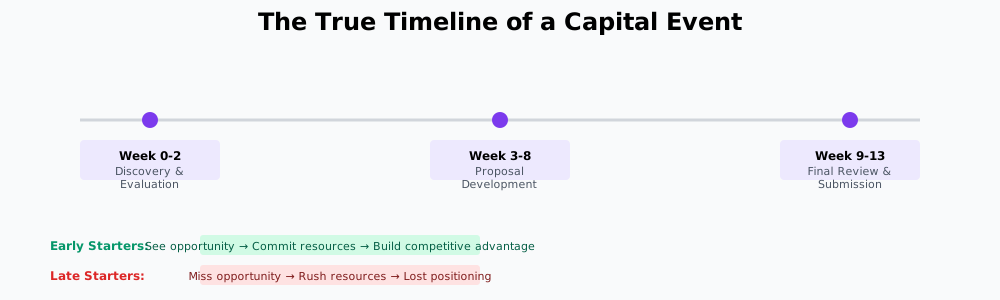
Figure 1: The real competitive timeline for capital events is weeks 0-2 (discovery & evaluation), not the 90-day deadline. Organizations starting in week 1 have 6+ weeks of lead time over those starting in week 4.
Weeks 0-2: The Visibility Window
When an opportunity is announced, organizations have 2 weeks to see it and decide to pursue it. This is where the competition separates. Early movers assign a proposal manager immediately, begin customer research, and start outlining their approach. They're committing resources while others are still debating whether to look at it.
If your organization doesn't see the opportunity until week 3—because you don't have systematic monitoring in place—you've already lost your early positioning window. Your competitor has a 2-week head start they'll never surrender.
Weeks 3-8: The Iteration Window
This is where quality is built. Organizations that started early can do 5-7 proposal iterations: draft, review, incorporate feedback, refine, stress-test, polish. Organizations that started late do 1-2 iterations and submit first drafts.
Federal evaluators see this difference immediately. An early proposal has coherent narratives, addressed edge cases, and polished compliance matrices. A late proposal reads rushed and reactive.
Weeks 9-13: The Final Push
Early movers do final reviews, bring in external reviewers, and stress-test their approach one more time. Late movers are submitting whatever they have.
What That Timing Difference Actually Costs You
Let's quantify the real cost of being late. Using a conservative $5M federal contract as an example:
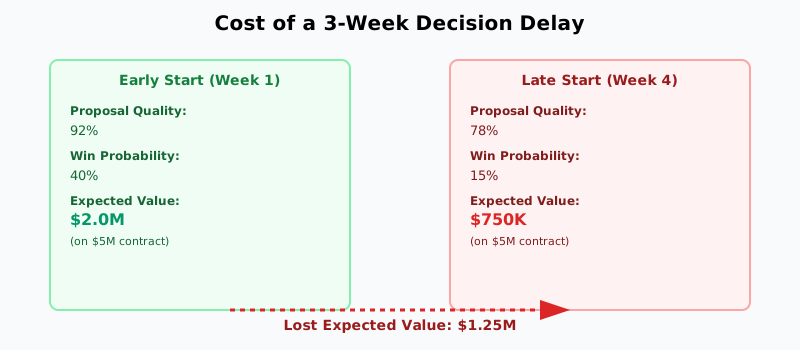
Figure 2: A 3-week delay in proposal start reduces win probability from 40% to 15%, costing $1.25M in expected value on a single $5M contract.
The Win Probability Math
Early starters have 2 advantages: higher quality proposals (from iteration) and better positioning (from early research and networking). Federal evaluators typically award based on published scoring rubrics. When two proposals compete:
- Week 1 Start: 92% quality proposal → 40% win probability
- Week 4 Start: 78% quality proposal → 15% win probability
Expected value of early start: $5M × 40% = $2.0M
Expected value of late start: $5M × 15% = $750K
Cost of 3-week delay: $1.25M in lost expected value
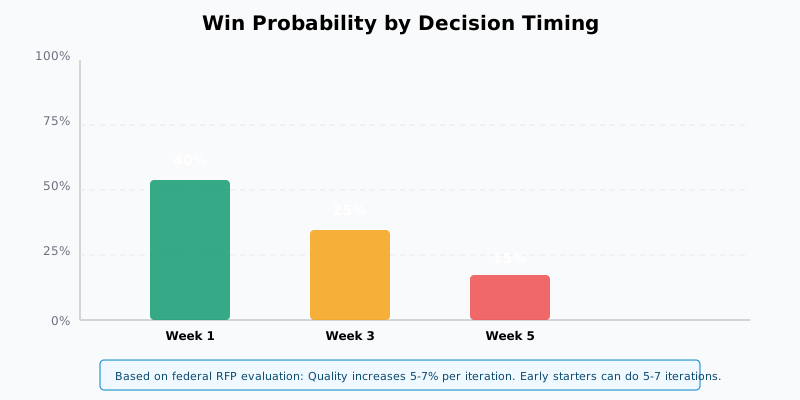
Figure 3: Win probability drops 15-25% for every week of delay in starting proposal development. Organizations that see opportunities first compound their advantage.
Beyond the Single Contract
Most organizations pursue 3-5 major capital events per year. Missing one due to slow decision-making costs more than just that contract:
- Demoralization: The team that lost becomes risk-averse about pursuing other opportunities
- Resource Strain: Budget allocated to the lost opportunity is gone, reducing capacity for other pursuits
- Competitive Erosion: Every contract you lose to faster competitors becomes a reference for them and a confidence loss for your organization
- Capability Decline: Organizations that don't pursue consistently don't build proposal capability. Proposal managers don't get better. Processes don't improve.
Over 3 years, slow decision-making costs not just millions in lost contracts but also organizational erosion that makes future competition even harder.
Why Most Organizations Are Trapped in Slow Decision-Making
The cost is clear. So why do organizations continue moving slowly? It's rarely about laziness or poor intent. It's about gaps in how they've structured their approach to capital opportunities.
Gap 1: Visibility
Your team doesn't see opportunities in week 1 because you're not monitoring the sources where they appear. SAM.gov for federal contracts, Grants.gov for federal grants, agency websites for agency-specific opportunities, Federal Register for announcements. Most organizations rely on word-of-mouth or reactive browsing instead of systematic monitoring.
The fix: Digital monitoring. This doesn't require people. Tools like Capital Event Intelligence systems continuously scan these sources and alert your team when relevant opportunities appear. Instead of your team finding opportunities, opportunities find your team. This collapses weeks 0-2 from invisible to immediate.
Gap 2: Evaluation Speed
Even when you see an opportunity, evaluating whether to pursue it takes weeks. Should we pursue this? Are we qualified? Is it strategically aligned? These questions need answers before committing resources.
The fix: Pre-built evaluation framework. Before opportunities arrive, define your go/no-go criteria in writing: "We pursue opportunities in sectors X, Y, Z. Deal size between $A and $B. With customer types C, D, E." When an opportunity appears, a Capital Event Intelligence system can evaluate it against these criteria automatically, reducing evaluation from weeks to hours or days.
Gap 3: Resource Commitment Authority
Even if evaluation is fast, committing resources takes time. A proposal manager sees the opportunity and wants to start proposal development. But they don't have authority to commit team members or budget without approval. They escalate. Escalation takes meetings. Meetings compound.
The fix: Pre-authorized decision authority. Agree in advance: "If an opportunity meets these criteria, we pursue it. The proposal manager has authority to commit up to $X in resources without additional approval." This eliminates the approval bottleneck entirely. When the opportunity qualifies, work starts immediately.
Gap 4: Execution Infrastructure
Even with visibility and quick decision-making, starting from scratch on execution is slow. Your proposal team needs to write company background, assemble team credentials, create budget templates, and document past performance. Each proposal restarts this work.
The fix: Template-first execution infrastructure. Build before opportunities arrive: standard company background, team credential templates, budget frameworks, past performance examples, compliance requirement checklists. When an opportunity appears, you customize existing materials instead of creating from zero. A Capital Event Intelligence system can suggest which templates and materials align with each opportunity, further compressing timeline.
The Digital Employee Advantage
The organizations winning in 2026 aren't hiring more people. They're deploying digital employees—systems and tools that do the routine work of capital event management.
- Monitoring: A digital employee watches the sources continuously, never missing an opportunity announcement
- Evaluation: A digital employee screens opportunities against your criteria, surfacing only the ones worth human consideration
- Qualification: A digital employee validates whether you're actually qualified, identifying capability gaps early
- Suggestion: A digital employee suggests which existing templates, materials, and team members are relevant to each opportunity
A Capital Event Intelligence system is digital employees working 24/7 on the routine work of capital event management. This lets your human team focus on proposal strategy, customer relationships, and quality instead of the routine work of finding and evaluating opportunities.
How This Compounds Over Time
2026 is a year of unprecedented capital availability. Federal spending on infrastructure, AI, semiconductors, and clean energy is flowing in unprecedented quantities. Organizations that move fast win disproportionately.
But speed isn't just a 2026 advantage. Organizations that build capital event infrastructure in 2026 get better every year:
- More opportunities pursued → More proposal iterations → Higher quality proposals
- More wins → Better case studies → Stronger positioning for future competitions
- Winning culture → Team develops deeper expertise → Capability compounds
- Digital employees handle routine work → Team focuses on strategy → Competitive advantage widens
Organizations that don't move fast fall further behind every year. Slow is an accelerating disadvantage.
The Decision Ahead
A 3-week delay on a single $5M opportunity costs $1.25M. But the real cost is cumulative. Over 3-5 years, slow decision-making costs millions in lost capital events plus the organizational erosion that makes future competition harder.
The good news: Speed is buildable. You don't need better people. You need better systems. You need Capital Event Intelligence working for you. You need pre-built evaluation frameworks and execution infrastructure. You need clear decision authority. You need digital employees doing the routine work so humans can focus on strategy.
Organizations that build this infrastructure in the next 90 days will win disproportionately in 2026 and beyond. Organizations that don't will lose millions in capital they never even saw coming.
Ready to Build Organizational Speed?
Speed on capital events requires infrastructure. Start by understanding where your organization is today and what you need to build.
Find Your ClusterFree Claude Skill. Takes 5 minutes.