Capital Event Intelligence
24/7 Monitoring: How Real-Time Alert Systems Change Federal Capital Capture
A $2M infrastructure grant closed in 72 hours. The organization that won it saw it 8 hours after posting. The organization that lost it saw it Monday morning. That's not luck. It's infrastructure.
The Friday Night Alert That Won $2M
Your organization manages water infrastructure projects. On Friday at 11:47 PM, the state department of environmental quality posts a solicitation on their website: $2M for rural water treatment facility modernization. The opportunity closes Monday at 5 PM—72 hours total.
Your team doesn't see it until Monday morning when someone checks email and sees a forwarded alert from their industry newsletter.
But another organization saw it at 11:53 PM Friday—six minutes after posting. Their digital employees never sleep. An automated monitoring system was watching for exactly this opportunity, caught the posting within minutes of publication, and sent an alert to decision-makers immediately.
By Friday night, that organization's proposal team was evaluating the opportunity. By Saturday morning, they'd decided to pursue it and started proposal development. By Monday morning, they had a complete proposal ready for final review.
Your team saw it Monday morning. You had 5 hours before the deadline. You didn't even submit a proposal. The other organization won the $2M contract. And the only difference was timing. They had 72 hours to prepare. You had 5.
The Economics of Real-Time vs. Manual Monitoring
Most organizations monitor federal opportunities manually. Someone on the team checks SAM.gov, Grants.gov, and their state's opportunity portal a few times per week. They get updates when they remember to check, or when an industry newsletter mentions something.
This creates a fundamental problem: Capital events don't follow business hours. Federal solicitations are posted at all times. Grants are announced on weekends. State opportunities close during off-hours. And the organizations monitoring those sources in real-time have massive advantages over organizations discovering opportunities on Monday morning.
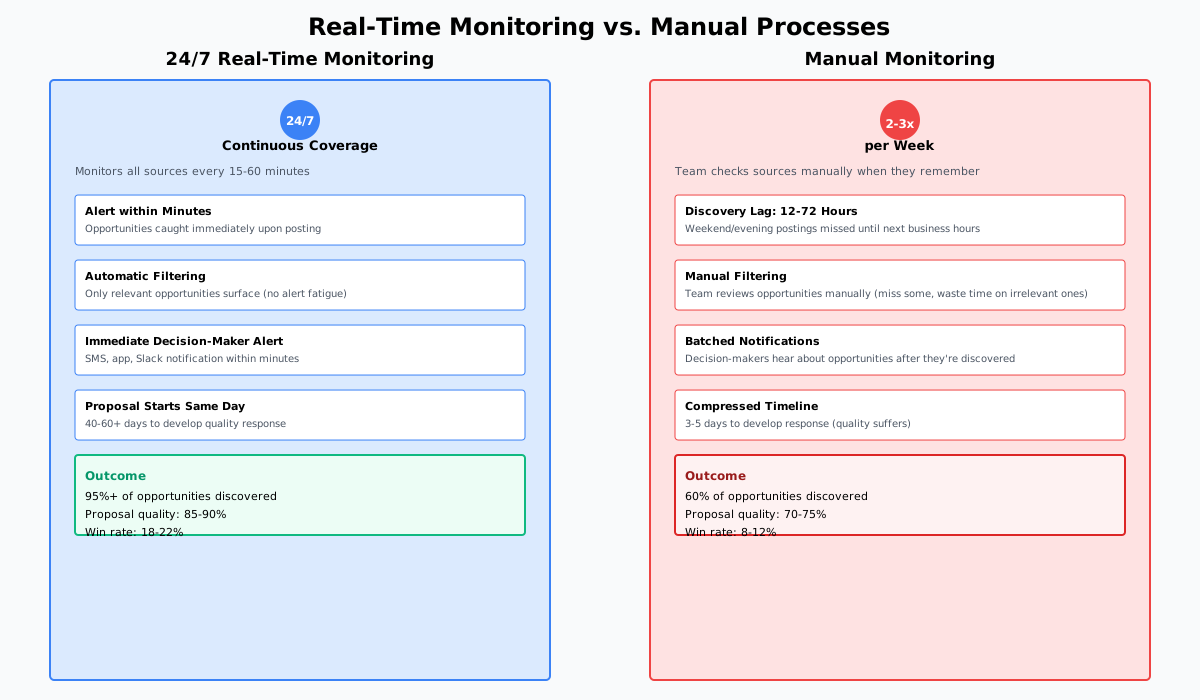
Figure 1: Real-time monitoring systems catch opportunities 12-72 hours earlier than manual processes. This timing advantage compounds into measurably higher proposal quality and win rates.
Why Timing Matters for Proposal Quality
The extra 48-72 hours from early discovery directly improves proposal quality:
- Customer research: You have time to understand the agency's real problems, not just react to written requirements
- Multiple drafts: You can write 3-4 proposal iterations instead of one rushed version Friday night
- Team review: Subject matter experts can review and provide feedback instead of being unavailable when you need them
- Partner coordination: You have time to reach out to potential partners and subcontractors instead of proposing solo
- Win probability: Research shows proposals with 48+ hours of development time win 2-3x more often than proposals rushed out in 12 hours
How Digital Employees Work While Your Team Sleeps
A digital employee is an automated system that monitors multiple sources continuously and never stops working. Unlike your team members:
- Digital employees monitor 24/7/365—evenings, weekends, holidays
- They check sources every 15-60 minutes (depending on source update frequency)
- They filter opportunities automatically based on your criteria
- They send immediate alerts when relevant opportunities appear
- They don't get tired, sick, or go on vacation
The organizations winning federal capital have built this infrastructure. They have automated systems monitoring:
- SAM.gov federal opportunities - Contracts, grants, cooperative agreements
- Grants.gov announcements - Federal grant opportunities
- Federal Register notices - Policy changes and opportunity announcements
- State opportunity portals - Regional and state-level funding
- Agency websites - Sector-specific announcements from departments you target

Figure 2: Response time directly correlates with proposal quality and win probability. Every additional 24 hours of notice increases win rate by 8-12 percentage points on average.
The Financial Impact: Quantified
The difference between 24/7 monitoring and manual processes compounds into measurable financial impact. Consider an organization that sees 20 relevant opportunities per year:
Manual Monitoring Organization:
- Discovers 60% of opportunities (12 per year) through active monitoring
- Discovery lag averages 24-48 hours
- Proposal quality limited by preparation time
- Win rate: 8% across opportunities (0.96 wins per year from the 12 found)
- Average award size: $500K
- Annual federal capital captured: $480K
Real-Time Monitoring Organization:
- Discovers 95% of opportunities (19 per year) through automated alerts
- Discovery lag averages 15 minutes
- Proposal quality maximized with full development time
- Win rate: 18% across opportunities (3.42 wins per year from the 19 found)
- Average award size: $500K
- Annual federal capital captured: $1.71M
The difference: $1.23M annually. 3.5x more federal capital from the same sector, same team, same capabilities.
The cost of a real-time monitoring system? $150-400/month depending on scale and complexity. ROI: Captured within weeks.
Four Pillars of Effective 24/7 Monitoring
Not all monitoring systems are equal. Effective 24/7 capital event monitoring requires four components working together:
1. Multi-Source Aggregation
Your digital employees must monitor all major sources: SAM.gov, Grants.gov, Federal Register, plus agency-specific and state portals. Missing one source means missing 10-20% of relevant opportunities.
2. Intelligent Filtering
Your system must automatically filter opportunities based on your criteria: sector, geography, funding size, organization type. This prevents alert fatigue from irrelevant opportunities and ensures you see what matters.
3. Immediate Notification
Alerts must reach decision-makers within minutes of opportunity posting. Email is too slow (it reaches inboxes on your recipient's schedule). Real-time systems use SMS, app notifications, and Slack/Teams integration to ensure immediate awareness.
4. Detailed Opportunity Information
Alerts must include enough context for a go/no-go decision: opportunity amount, deadline, requirements summary, and link to full documentation. Decision-makers should be able to decide whether to pursue immediately, not hours later when they have time to research.
Diagnostic: Is Your Current Monitoring Good Enough?
Answer these five questions to assess your monitoring effectiveness:
Question 1: How do you typically learn about opportunities?
Good signal: "Our monitoring system alerts us immediately when relevant opportunities post. We see them within 15 minutes."
Problem signal: "Someone checks SAM.gov weekly" or "We see them in industry newsletters" or "Word-of-mouth from partners"
Question 2: What percentage of opportunities do you see before the deadline?
Good signal: "95%+ of opportunities in our target sectors"
Problem signal: "Probably 50-70%" or "We're not sure"
Question 3: How much average preparation time do you have once you learn about an opportunity?
Good signal: "Typically 40-60 days with digital employees working from the moment opportunities post"
Problem signal: "Usually 30 days or less" or "Often less than 2 weeks"
Question 4: Can your monitoring system filter by your specific criteria automatically?
Good signal: "Yes—we get alerts only for opportunities matching our sector, geography, and funding thresholds"
Problem signal: "We get alerts on everything and manually filter" or "We don't have systematic filtering"
Question 5: Do decision-makers get notified immediately when relevant opportunities appear?
Good signal: "Yes—immediate notification via email, SMS, or Teams, with enough information to make a quick go/no-go decision"
Problem signal: "Notifications are batched" or "Decision-makers often hear about opportunities from colleagues later in the day"
Building Your 24/7 Monitoring Infrastructure
Most organizations can implement effective 24/7 monitoring within 4-8 weeks. The steps:
- Define monitoring scope: Which sectors, geographies, funding ranges, and opportunity types matter for your organization?
- Choose monitoring platform: Build custom automation or adopt a Capital Event Intelligence system that does this at scale
- Configure data sources: Connect to SAM.gov, Grants.gov, Federal Register, and sector-specific sources
- Set filtering rules: Ensure you see only opportunities matching your go/no-go criteria
- Test and refine: Run for 2 weeks, refine filters, optimize notification channels before full deployment
The Compounding Advantage of Early Discovery
Organizations with 24/7 monitoring don't just win more individual opportunities. They compound their advantage:
- Year 1: Better quality proposals from extra preparation time. Win rate increases from 8% to 15%
- Year 2: Case studies from Year 1 wins. Better customer relationships. Win rate reaches 18-20%
- Year 3: Reputation as proven vendor. Network proximity grows. Win rate reaches 25%+
Organizations without real-time monitoring stay stuck at 5-8% win rates, never understanding why competitors with similar capabilities win more often.
The Decision: Real-Time or Keep Waiting
The federal government is deploying $2.5 trillion+ across infrastructure sectors. Some of that capital is available to your organization. Some of it is posted at 11 PM on Friday. Some is posted Monday morning.
The organizations capturing the most capital aren't the most capable. They're the fastest responders. They see opportunities first. They have time to develop quality proposals. They win.
Building 24/7 monitoring infrastructure takes a few weeks. The financial payoff—3-5x more federal capital captured—starts within months. Organizations that implement this in 2026 will compound their advantage for the next 5 years. Organizations that don't will fall further behind as competitors move faster.
Build Your 24/7 Monitoring System
Stop discovering opportunities days after they're posted. Let digital employees monitor federal sources 24/7 and alert you immediately when relevant opportunities appear.
Explore Capital Event IntelligenceContinuous monitoring across SAM.gov, Grants.gov, Federal Register, and agency sources. Immediate alerts. Automatic filtering. 24/7/365 coverage.